The Ultimate Spring Break
How Hawkeye Service Breaks Provide Meaningful Experiences
by Nic Cazin
In the spring of 2024, a group of University of Iowa students piled into a car and drove to Nashville, Tennessee, for a school-sponsored spring break trip unlike any other.
Far from the beaches and sunshine college students typically look for in the week off that falls mid-March, the students worked with the homeless population to make a real community impact. They brought mobile showers to tent cities and learned about the different challenges the communities face, walking away from the trip with a new outlook on how to help their own locality.
These students, along with three other groups that year, participated in the Hawkeye Service Break program. Offered in the spring semester, students take a three-semester-hour course, ending the Thursday before spring break. The groups then spend their break in a different state and work alongside a volunteer organization. Beside the $270 course fee when registering, the university covers basically all costs, including transportation and hotels.
While this program is open to all UI students, those in the Honors Program receive the added benefit of experiential learning credit for University Honors.
Third year honors student and peer mentor Ali Meredith has had her fair share of experiential learning. As an honors peer mentor, she has also assisted other honors students with finding unique and beneficial experiential learning opportunities.
“The Honors Program really emphasizes the reflection process of [experiential learning],” Meredith said. “It’s not only going out and getting the experience; it’s taking what you learned from that experience and reflecting on how you grew personally, academically, or professionally. That’s the most important part.”
Hawkeye Service Breaks offer built-in opportunities for engagement and reflection. Leah Sweeney is the coordinator for the program as well as an instructor. With a passion for event management and working with students, she wanted to provide beneficial and impactful experiences to the UI student body.
“Opportunities outside of the classroom, even if it's related academically, are valuable,” Sweeney said. “[Students are] getting a chance to go see a different community and some of the things that challenge those communities. That's beneficial because I think one of the points of education is to make people better citizens.”
While helping your local community is always a good thing, Hawkeye Service Breaks allow students to experience those communities Sweeney mentioned firsthand.
“We often have this grand idea that we should go international, and while there's certainly something to that, I think we miss out on what's happening domestically,” Sweeney said. “Traveling, even if it's only six hours away, is beneficial to everyone.”
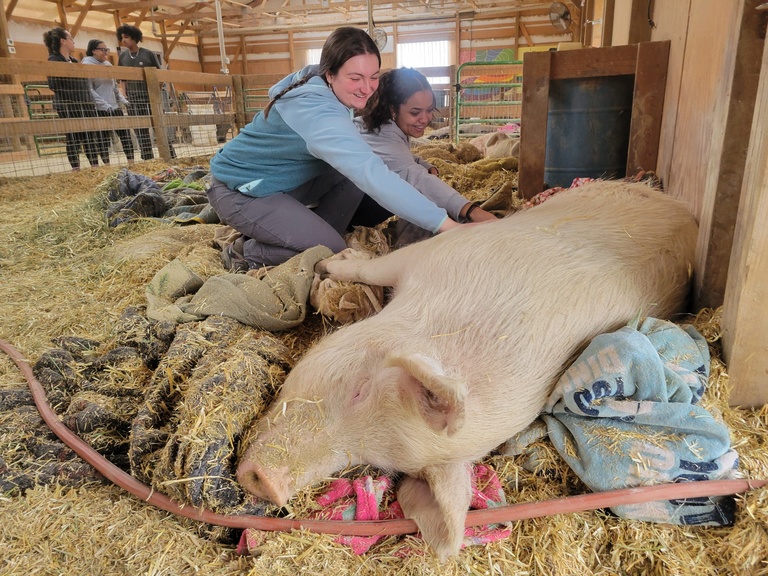
Ella Borho, a masters student in accounting, participated in a service break in the spring of 2024. Borho went to Denver, Colorado, working with her peers at Luvin Arms Animal Sanctuary, a nonprofit sanctuary housing abused and neglected farm animals. Her service focused on caring for the residents of the farm.
“I got to spend time with a cow named Tito, and he knew how to play soccer because of how much enrichment they do,” Borho said. “We helped take care of the residents and cleaned out their barn, and we learned about ahimsa, which is nonviolence to all [living] beings.”
Outside of the community service opportunities, Borho also got to experience the mountainous city. She saw clear differences between Denver and Iowa City as she walked around the sustainable downtown.
“You have to pay for plastic bags at any grocery store, [so] there’s a lot of people that bring their own reusable bags,” Borho said. “You don’t really see lots of plastic water bottles sold there. It’s a very diverse place [where] you see a lot of reusing and recycling.”
Hawkeye Service Breaks provide opportunities for students to branch out and try things unrelated to their major and potentially find a passion they can bring back to Iowa City. Seeing another city’s green initiatives, for example, may inspire a student to become more involved with an environmental organization on campus.
Additionally, the breaks are a great way to get hands-on experience within a student’s major. Kamilla Jacobo, a third year psychology major on the pre-medical track, went to Washington, D.C., to work with people experiencing food insecurity.
“I knew I wanted to go into medicine, and when I went on the D.C. trip, I learned a lot about health policy and things I never thought could be incorporated into medicine,” Jacobo said. “I did my own research and found the public health program.”
While in the country’s capital, the group worked with three organizations: Bread for the City, L’Arche, and Food for All of D.C. From hand packing and delivering meals to cooking for and eating with D.C. citizens, Jacobo experienced the challenges of redlining, a practice used to withhold services from marginalized communities.
“D.C. has a lot of problems with redlining; there are no grocery stores in some neighborhoods, [and in] those neighborhoods, it’s mostly minorities and low income individuals,” Jacobo said. “It really puts it into perspective of how privileged you can be to be near a grocery store.”
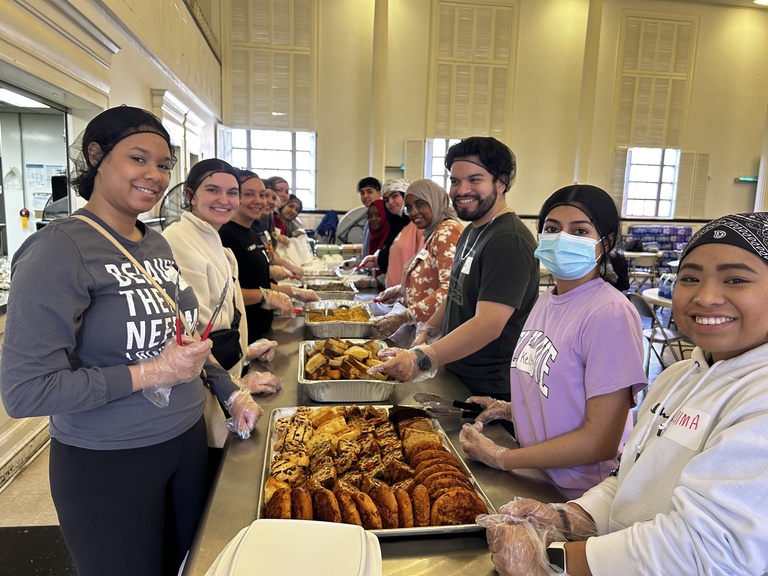
Before going on the spring break trip, students spend the first half of the semester in class and forming connections. Going across the country with a group of strangers is intimidating, so the instructors try to mitigate any anxiety. From cooking a majority of their meals as a group, having team leaders each day, and visiting tourist sites together, the students form a tight-knit community.
“We really try to coordinate and facilitate group building and team bonding so making sure everyone knows each other [so] there's a level of comfort,” Sweeney said.
The Hawkeye Service Break program provides students ample opportunities to experience the world and connect with their community. For honors students, this spring break trip is a great way to learn in the field, visit somewhere new, and help a community with its needs.
“I think exploring a new city while also dedicating time to volunteering is really important,” Jacobo said. “It’s just a great way to learn how different dynamics in a city work.”

About the Author
Nic Cazin is a first-year student at the University of Iowa double majoring in English and creative writing and ancient civilizations with a minor in French. From Wake Forest, North Carolina, Nic is planning on studying abroad in three different countries.