Stress to Success
Student Perspectives on the Pre-Health Path
By Reese Hartke
We’ve all heard the advice to “work hard now and it will pay off later,” but is the stress really worth it? For many honors students, the question is not abstract; it’s lived daily through labs, shadowing hours, research, and demanding course loads. Stress without direction can feel overwhelming, but stress paired with purpose builds resilience and skills needed for healthcare careers. Although the immediate benefits can be hard to see, today’s rigor sets students up for long-term success.

“Stress is something that comes with everyday life,” explained Ava Russ, a current honors student on the pre-med track. “A meaningful challenge is good for you and helps you grow as a person—and the Honors Program is filled with those.”
Beyond coursework, Russ embraced the dual challenge of academics and research. Through Honors, she discovered a lab position that not only enriched her education but also prepared her for medical school applications. For her, stress functions as a kind of “designed pressure,” not simply testing limits, but actively shaping her readiness for patient care.
The stress of pre-med life becomes sustainable with strong support. Advising, tutoring, and writing centers provide resources, while Honors-specific opportunities like Primetime sessions and experiential learning help students excel without becoming overwhelmed.
Peer support is equally vital. Russ serves as a peer mentor herself, guiding students through course planning and program requirements. She recalled her time living in Daum Hall, the former honors residence hall, as formative, describing her roommate and community as “essential” to managing the day-to-day pressures of Honors. Even now, she relies on the quiet, supportive spaces of the Blank Honors Center to balance her commitments.
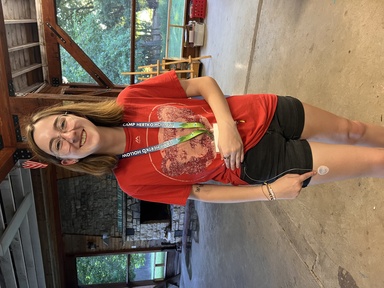
Academic, peer, and social networks transform stress from an isolating weight into a shared journey.
For Russ, the academic rigor of pre-health is undeniable. Yet, she emphasized that honors hasn’t added extra stress; rather, it has integrated into her program in ways that support her growth. Research opportunities, discussion-based classes, and strong peer connections made the challenges manageable.
“All of the stress builds a better application for medical school, which in turn grants a better experience. The more you prepare now, the easier it will be later,” Russ explained.
From designing posters on the medicinal properties of radium to working in a lab, Russ sees each project as a stepping stone, and her philosophy is clear: “The more you push yourself, the more resilient you will be. With each struggle comes each new gain.”
Honors alumni echo these lessons.
Klaudia Golebiewski, a fourth year medical school student applying for residency, recalled the honors Intro to Biology course as one of her toughest challenges, leaving her questioning her abilities in all aspects of her career. “Am I smart enough? Am I doing enough? Is it worth it?”
The pressure became preparation. Golebiewski reminded herself, “You deserve to be here…change your mindset and you will change your outcome.” That same perseverance now guides her through medical school.
Monisa Saravanan, now in her second year of residency for family practice, agreed, but with perspective: “To be completely honest, the honors specifics didn’t add to the pre-health stress, instead it gave resources on how to manage it.”
For Saravanan, hindsight is clear: “It’s crazy that I’m here now in residency, all of the doubts and challenges were worth it.”
Both alumni emphasize using positive self-talk and focusing on passions over resume-padding.
As Golebiewski put it, “Believing in yourself is the first step of seeing results.” What once felt overwhelming became training in resilience, adaptability, and professional growth.
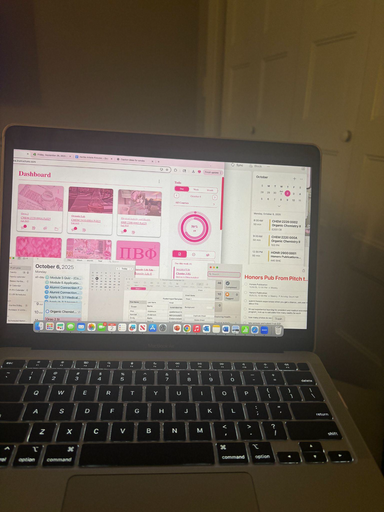
The challenges of undergraduate study are not roadblocks but preparation. Stress teaches adaptability, empathy, and endurance—all qualities vital in medicine. While medical school remains demanding, the struggles of undergrad build discipline needed to succeed.
Alumni also point to the practical benefits. Honors provides a “leg up” through research, mentorship, and faculty connections. For example, a strong relationship in the Honors Program led directly to a key recommendation letter that helped one alum gain admission to medical school.
Ultimately, stress transforms into competence. That competence leads to better outcomes, not just for students, but for patients, healthcare teams, and entire communities.
The journey from an undergrad to an alumnus makes one truth clear: stress is not an enemy but a training mechanism. In the moment, it can feel heavy, filled with doubt and deadlines. But with support, positive mindset shifts, and perseverance, those same struggles become fuel for long-term success.
Alumni like Golebiewski and Saravanan, now thriving in medicine, see their hardest moments not as setbacks but as stepping stones.

About the Author
Reese Hartke is a third-year honors student majoring in health studies on the pre-med track, with a certificate in entrepreneurial management. She plans to graduate in May 2027 and pursue a career in pediatric healthcare. Balancing the demands of a rigorous academic schedule with research, mentorship, and campus involvement, Reese exemplifies how honors students navigate stress and transform it into preparation for the future medical field.