Honors and Letters are Not Separate Worlds
How Iowa’s Honors Students are Leading Sorority Life’s Next Chapter
by Reese Hartke
Sorority life at the University of Iowa has undergone a quiet revolution, and honors students are the ones who drove it.

Far from the old stereotypes, sororities have become powerhouse communities where scholarship, service, wellness, and leadership take center stage. It was Sorority life reimagined — a purpose-driven culture that reflected what it meant to “live with honor.”
According to Alpha Chi Omega president and honors student Emma Lephart, a University of Iowa (UI) third year health promotion major, leading her chapter strengthened both her academics and sense of connection.
“My time as president made me a stronger student — more organized, more intentional, and more motivated to represent the excellence I saw in my members,” Lephart said.
Under her leadership, Alpha Chi Omega launched initiatives like study sisterhoods (where girls gathered in a study space to set aside dedicated time to study), wellness walks led by mental health chairs, and cultural celebrations such as a Mexican Independence Day dinner. Each program was designed to foster balance, inclusion, and belonging.
Alpha Delta Pi member and honors student Ansley Tonkovic, a UI first-year, sees sorority life and honors coursework as complementary.
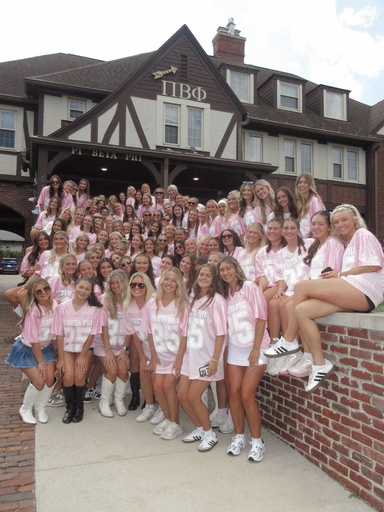
“Honors pushed me to think critically and manage my time, and that carried over into sorority life,” she explained. “Both Honors and sorority life provided opportunities for leadership and experiential learning.”
Tonkovic highlighted her chapter’s support for academics, with study hours that allowed members to collaborate and thrive. She also emphasized sorority life’s inclusivity.
“Sorority life helped me find a home, get involved, and learn to lead. Living with honor meant connecting with people in a meaningful way and treating others how they wanted to be treated,” she said.
Leadership in sorority life also offers real-world experience. Pi Beta Phi’s Policy and Prevention Education Chair, Nora Vanhorn, a UI third-year, organized workshops for more than 200 women — honing skills like communication, motivation, and accessibility.
These were lessons, she said, “you couldn’t learn in a classroom.”
Former Panhellenic Council executive Riley Rosenmeyer, a UI fourth year, added that academically driven students, such as those in the Honors Program, played a key role in shaping chapter culture. Their influence fostered programs that strengthened relationships, built support systems, and created meaningful opportunities for experiential learning.
Sorority life also evolved to support students balancing academics and leadership.
“It was less about balancing everything and more about prioritizing what mattered,” Lephart said. “Some days that was academics; other days it was supporting your sisters, but it was always about showing up with purpose.”

Chad Warrick, staff advisor for UI Fraternity and Sorority Life, refers to sorority life a “laboratory for leadership,” where students learn collaboration, time management, conflict resolution, and community engagement.
For Lephart, the most rewarding moments were personal, not ceremonial.
“My proudest moment wasn’t about awards. It was knowing members felt safe coming to me with concerns — that’s what it meant to lead with honor,” she said.
Vanhorn agreed: “Living with honor was about leading with empathy and intention — serving your community and using your influence to make things better.”
Honors students at the UI demonstrate that the letters they wear and the honors they earn are not separate worlds. Sorority life and the Honors Program can be intertwined expressions of the same commitment: to live, learn, and lead with distinction.

About the Author
Reese Hartke is a third-year honors student majoring in health studies on the pre-med track, with a certificate in entrepreneurial management. She plans to graduate in May 2027 and pursue a career in pediatric healthcare. Balancing the demands of a rigorous academic schedule with research, mentorship, and campus involvement, Reese exemplifies how honors students navigate stress and transform it into preparation for the future medical field.