Pushing Limits
How Honors Student-Athletes Find Their Balance at Iowa
by Ania Naso
For students like Nate Hara, Brynn Storhoff, and their peers, success isn’t about choosing between athletics and academics, but rather thriving in both.
Nate Hara, a first year from Northbrook, Illinois, came to Iowa determined to push himself. A political science major on the pre-law track and pursuing a certificate in Jewish Studies, he viewed the Honors Program as a way to stay challenged. He believed honors coursework would be a great thing to set himself apart from other applicants applying for law school.
Brynn Storhoff, a second year student and member of the Iowa Women’s Rowing Team, joined the Honors Program for a different reason — connection. Coming from a small town where community was everything, she was looking for that same sense of belonging on campus.
“I wanted to find a community like that on campus,” said Storhoff, who majors in counseling and behavioral health services as well as sport and recreation management. When I visited Iowa, I went to the Honors Program panel session, and just listening to the students who spoke that day, I was like, yeah — Honors is where I could find a community of people at Iowa.”
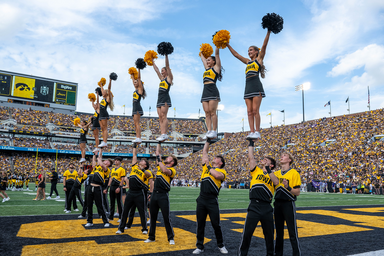
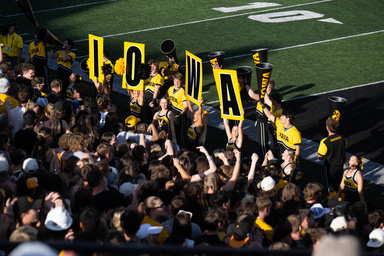
While their motivations differed, both students shared an instinct for a sense of belonging within this unique community on campus, and their own individual growth as a result of the program. Hara’s introduction to college life included not only rigorous courses but also his spot on the Iowa Cheer Team, following in his father’s footsteps as a Division I athlete.
“I got into cheer in middle school,” Hara said, “and then junior year, I started going to recruitment clinics all over different schools, mostly Big Ten. I loved the ones at Iowa. The coaches were phenomenal, just the way that they interacted with everyone. And then the team dynamic—it all just made me feel comfortable and like something I wanted to be a part of.”
Storhoff’s athletic journey began later. She joined rowing the summer before freshman year and found that her sport and her studies soon began to reflect the same lessons. She spoke about how the Honors Program really shifted her perspective to a place of deepened learning and helped her to truly enjoy every experience and opportunity present. Specifically, a shift in her mentality as a result of the program when it comes to grades, and how she no longer lets a bad grade define her as a student.
For both, the Honors Program has become a big part of their journeys when it comes to managing their packed schedules.
“It’s definitely been a lot to find a balance,” Hara admitted. “I just joined a fraternity, so it's a big time commitment, but you make it worth it because you want to do it. I wouldn't be doing all this if I didn't want to be a part of it, if I didn't have passion for it, if I didn't love it.”
Storhoff agreed that finding balance takes discipline.
“I’m very schedule-oriented,” she said. “I have a planner I fill out every week, and a digital calendar that’s always updated. I plan what I do before and after practice, which helps me balance everything. I hold myself to standards, but I also allow for breaks when I need them—especially during 20-hour training weeks.”
The structure of the Honors Program, they both noted, provides a healthy amount of challenge as well as a tremendous amount of support. Hara appreciated the smaller class sizes and personal connections with professors, and how they really hold you accountable. He noted the sense of community found in these smaller classrooms in contrast with a huge lecture hall.
“I’m able to get that stronger understanding of the material. If I have something for cheer going on or religious obligations, professors have been able to work with me. It’s definitely been beneficial and has improved my experience at the University of Iowa.”
Storhoff has found similar guidance, crediting Dr. Hill’s Honors Student in Wellness course for helping her close the gap between academics and athletics.
“That class dramatically changed my perspective as an honors student, but also as a student-athlete,” she said. “We touched on topics

like perfectionism, imposter syndrome, and mental well-being. Those conversations helped me see how to apply what I learn in honors to my life as an athlete.”
Both agreed that the Honors Program helped them bring intention and reflection into everything they do.
“Everyone in the Honors building is here for a purpose,” Hara said. “We’re all claiming our education, not just receiving it. Everyone wants the best for themselves in the classroom. It’s just a place that fosters growth.”
Storhoff found that same energy within her own team.
“I’m super fortunate—there’s a good number of my teammates in my class who are also in the Honors Program,” she said. “We were able to go through the first-year seminar together, which helped us build relationships both as teammates and as honors students.”
For both Hara and Storhoff, the intersection of athletics and honors isn’t just about balancing time, but about bringing the same drive, curiosity, and sense of purpose to every part of life at Iowa. Whether it’s a 6 a.m. practice or a late-night study session, both students prove that excellence doesn’t come from choosing between passions, but from utilizing all resources offered and pursuing both with their full hearts.

About the Author
Ania Naso is a first-year student from Iowa City majoring English and creative writing and secondary education. Upon graduation, she plans to volunteer abroad as an English teacher.