Slowing Down for Deeper Understanding
Honors Students in Healthcare Reflect on Internships
by Natalie Thomas
Fast-paced, intense, demanding: healthcare work is not for the faint of heart, whatever form it takes. Often, little emphasis is placed on looking back on one’s growth and learning. However, the University of Iowa (UI) honors program creates a unique opportunity to change this by asking students to write reflections on relevant positions and projects as part of the experiential learning requirement.
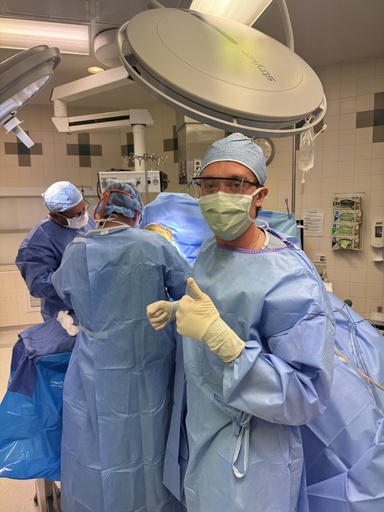
For UI honors students in healthcare, this allows them to look back on their work with patients and see how they have grown. Some students, like Vincenzo Dimarco and Ellie Hyten, have shared their reflections on the Honors Program blog called Note to Self.
Dimarco, a fourth-year honors student majoring in human physiology on the pre-med track, has reflected on two healthcare positions for honors experiential learning. He began working in an orthopedic office in high school in March of 2023 and continues to work there on school breaks.
Dimarco had assisted in surgery for a patient who broke their arm and got to see that patient’s recovery several weeks later. While writing, he realized how much he enjoyed seeing patients’ recovery progress.
“Seeing that full transition of allowing this patient to get back to their daily life was very fulfilling for myself,” Dimarco said.
He was later hired as a medical assistant at Endeavor Cardiovascular Institute. In contrast to the orthopedic job, he was now seeing patients with long-term cardiac conditions, which allowed him to think more about continuity of care. In Dimarco’s blog post titled “EKGs and Empathy,” he writes about the challenge of managing the high patient volume while also providing empathetic care for patients.
Sharing his reflection on the blog was a purposeful next step: “I liked that it gives people a space to share authentic experiences in medicine. It felt like the right place to express something meaningful that might resonate with other students learning how to balance technical skill with compassion,” Dimarco said.
Fourth year health sciences student Hyten expressed a similar sentiment when it came to publishing her writing on Note to Self; she was glad that her reflection was shared since it could encourage others working in healthcare.
Hyten aims to work in nursing and spent 20 hours a week as a caregiver/nurse aide and dining aide at Stillwater Senior Living from May to August of 2025. Like Dimarco, she had never written a reflection on her healthcare work before.
“This is the first time I looked at it from a new perspective and kind of dove deeper into the why behind my work and why I enjoy nursing so much,” Hyten said. “It was really fun looking at it through fresh eyes.”
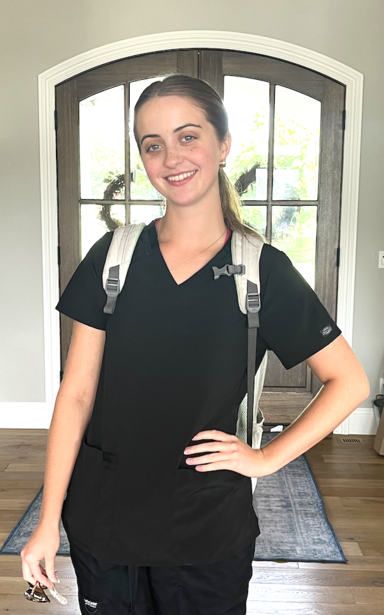
Her piece, “People Before Patients,” expressed that her position was demanding, but she pushed forward and rose to the challenge. As a result, she learned many skills and made an impact on the lives of the seniors she served. Writing this piece reinforced her passion for serving senior citizens in care facilities, who face unique social and spiritual challenges.
“Oftentimes, the caregivers giving their medicine is [the patients’] main interaction for the day, so it’s so important for us to prioritize relationships, especially amongst those individuals,” Hyten explained.
BotDimarco and Hyten see reflection as a beneficial practice for medical professionals.
“It helps you slow down, recognize how much you’ve grown, and process the emotional side of patient care that often gets overlooked,” Dimarco noted.
Hyten noted the nature of healthcare work makes it easy to get burned out and lose sight of why one is in the profession, but reflecting reminds healthcare professionals of the reason behind their work. Thinking deeply about patient care experiences doesn’t have to stop after college. Journaling, writing groups, and other programs can keep this beneficial practice going long after graduation.
Hyten said she could see herself doing reflection work in the future: “I am sure that I will have experiences that inspire me to write and share my story with others.”

About the Author
Natalie Thomas is a second-year student from Cedar Falls, Iowa studying English and creative writing on the publishing track with a certificate in medieval studies. She enjoys writing and reading psychological fiction and her favorite book is Crime and Punishment by Fyodor Dostoevsky.