Research Ready
The Advantages of Getting Involved as an Undergraduate
By Ellen Tews
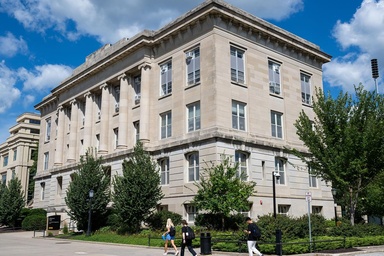
On Anne T Cleary Walkway, across from the Pentacrest, Gilmore Hall stands proud. Though housing only one university classroom, opportunities thrive in its basement. In room 6 of Gilmore Hall, one of the most impactful university resources is offered, the Office of Undergraduate Research (OUR), where staff members Tawny Tibbits, Liz Saathoff, and Laura Kowalski-Bliss work with students to find research options that align with their field of study and their various interests.
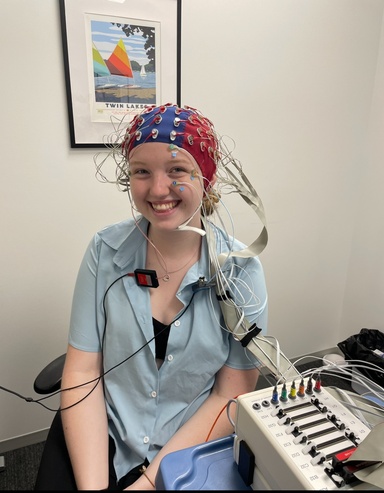
Though there are numerous research opportunities that take place in a lab, the possibilities range from creating dance choreography to researching nearby parks from an environmental perspective. OUR not only provides students hands-on learning, but it also helps students discover a greater sense of professional and personal development.
Many honors students take advantage of this resource as they explore their options for experiential learning.
Originally, the university’s undergraduate research office was housed in the Blank Honors Center and administered by Honors Program staff. In 2019, to better serve all undergraduate researchers, the office moved to Gilmore Hall with its own leadership.
Over the years, the office has implemented various strategies to get an array of students involved in research. One of these includes the OUR ambassador program consisting of 27 passionate students, 19 of whom happen to be honors students. This program is designed to build student interest and knowledge of research by learning about the experiences of their peers.
Ellie Wojcikowski, an honors peer mentor, is one of these ambassadors. She is a senior majoring in neuroscience with minors in Spanish and psychology. She is also working towards her certificates in clinical and translational sciences.
Wojcikowski has been a research assistant since her first semester on campus back in fall of 2022. Her research opportunities are well aligned with her academic track as she has worked in three kinds of neuroscience-related research labs.
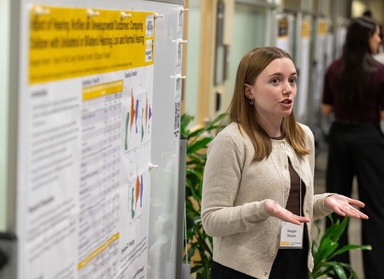
Since her first semester, Wojcikowski has worked in a clinical psychology lab called Mechanisms of Adult and Youth Psychopathology Lab (MAYPL). This lab focused on using biomarkers or biological signs to measure psychological resistance to factors along the schizophrenia spectrum.
Two years into MAYPL, Wojcikowski joined another research opportunity, the Parker Lab. This lab covered the basic aspect of neuroscience, including counting and staining neurons. Currently, Wojcikowski is working with an app to assess people’s reflexes.
“I have been all across the research–what they call the translational spectrum, which kind of ties to my certificate. Just from basic to working with people,” she observed.
This variety has given Wojcikowski hands-on experience, a deeper understanding of her studies, and greater clarity about her personal and professional goals, outcomes that reflect the missions of both the Honors Program and undergraduate research.
For Wojcikowski, they work together: “I feel like none of my experiences are separated, because they all kind of inform one another,” she said.
Furthermore, working in a professional setting with graduate students and faculty opened her eyes to new career opportunities in her field such as clinical jobs that do not require degrees.
“One reason I really chose Iowa was because I got the sense that undergraduate students were able to get involved–not just grad students or faculty or people with exceptional statistics or things like that,” she said. “You know, I thought research was the thing that scientists did. It was really that simple, but it turned into so much more than that.”
Leah Patton, a junior at the University of Iowa studying health sciences on the physical therapy track, emphasized the value of research
for students who are looking to further their studies. In her second year, Patton participated in the University of Iowa Physiology Lab, which focused on blood circulation in humans and how it differed from those with cardiovascular or metabolic disease.
As a result, she was “able to better visualize the variables and their results rather than just reading it from a textbook,” according to Patton.
Patton is planning to graduate a year early in May 2026 which “brings on the pressure to secure my future at a higher school,” she said.
Patton said she feels confident in interviews explaining her research and elaborating on her experiences, a practice cultivated by both undergraduate research and the Honors Program. Patton reflected that she has mentioned either research or honors in every single one of her applications and interviews.
Beyond talking about her experiences, Patton said she was well equipped to tour universities and view their lab settings. Because of her lab research, she recognizes most of what she sees, which allows her to better “determine her feelings about the campus.”
For both Wojcikowski and Patton, honors and research have helped shape their career interests and goals by introducing them to real-life models and metrics that will benefit them as they grow professionally.
Next year’s students will not find the OUR staff in stately Gilmore Hall, according to Tibbits, but at a new office space yet to be determined. Regardless of the location, however, undergraduate research at Iowa will continue to offer honors students and others opportunities for growth.

About the Author
Ellen Tews is a Tippie College of Business student from Bettendorf, Iowa, studying marketing and psychology. Looking forward, she hopes to focus her career on brand management and content management.