From Honors to the Courtroom
Exploring the intersection of the Honors Program and the pre-law track
By Maggie McKinney
One of the hundreds of areas of study and advising tracks offered at the University of Iowa for undergraduate students is the pre-law track. This track doesn’t add any additional requirements for graduation, but students are assigned a pre-law advisor who helps them navigate the law school admissions process.

Law schools do not prescribe a preparatory program of study, so those who study political science, dance, and engineering are all on equal footing in admissions. With no required coursework, how do pre-law students prepare? How do they gain the achievements that allow them to stand out? One answer is the Honors Program.
Courtenay Bouvier is a senior academic advisor at the University of Iowa who helps students with questions like these. “I think the two primary advantages would be being part of a cohort who are also intending to go to law school or graduate professional school and the requirement for experiential learning,” she said.
Experiential learning refers to the Honors Program’s requirement that students complete 12 honors credits in experiences such as study abroad, leadership, internships, research, or service learning.
“It’s very difficult to find pre-law experiences because you obviously can’t practice law,” said Abigail Adams, who is studying English and creative writing with minors in business administration and news and media literacy. “Sometimes you feel like you're kind of afloat.”
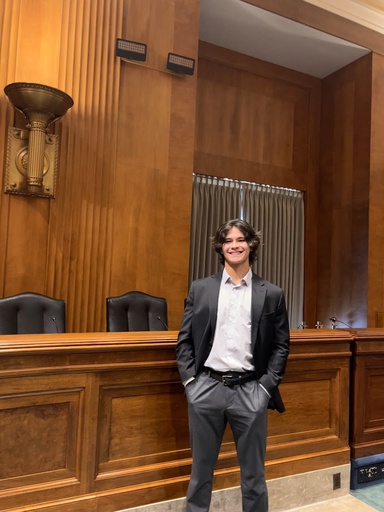
Adams, who assists other students as an honors peer mentor, detailed the ways the Honors Program addresses this, connecting students with their peers and professionals and challenging them to explore various forms of experiential learning.
One of the components of that experiential learning curriculum is deep reflection at multiple stages of the experience, which Adams drew upon to write her personal statement for law school.
Korbin Yauk is a fourth year anthropology major with minors in history and philosophy. Anticipating a career in public service, Yauk interned in Washington D.C. with the State Department in the summer of 2024, where he worked with the Bureau of Legislative Affairs doing research in preparation for congressional hearings. He also is currently a Law School Admissions Test (LSAT) tutor and a campaign intern for gubernatorial candidate Rob Sand.
“I think all of these experiences informed my perspective on law, even though I wasn’t a legal clerk or a legal assistant,” said Yauk.
Madhuri Belkale graduated in 2020 with a BS in psychology and political science and minors in Spanish and international studies. Belkale went on to get her JD at Columbia Law School and graduated in 2023. She worked at a class action law firm and now is working as a judicial law clerk for the U.S. district courts.
When reflecting on her time in the Honors Program, Belkale mentioned the fostering of curiosity. “Having curiosity about things beyond just what you directly are interested in can serve you really well in terms of thinking like a lawyer, and a lot of my honors friends pushed me in that way,” she said. “I was surrounded by folks who were very intellectually curious.”
In addition to the effects of motivated peers and the benefits of experiential learning, Bouvier highlighted parallels between honor classes being “smaller and more discussion based” and law school’s use of Socratic dialogue and the practice known as cold calling, where professors call on students and question them.
Alumnus Colin Votzmeyer reflected on how the Honors Program put him in “the right mindset” for law school.
Students in the Honors Program tend to be ambitious, hardworking and smart which, according to Votzmeyer, can foster imposter syndrome or feelings of not belonging.
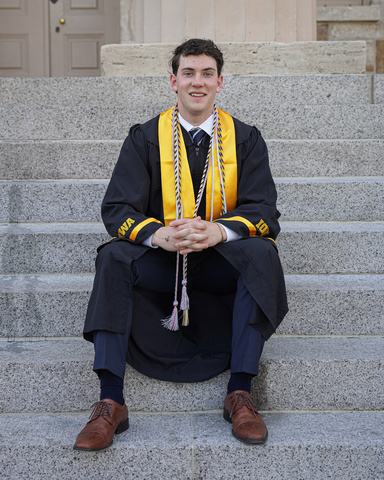
"You're sitting there and you’re like, okay maybe I'm not the smartest person in the room anymore. And that really pushes you to succeed,” Votzmeyer said.
A first-year law student at the University of Notre Dame, Votzmeyer received his BA in journalism and mass communications with minors in history and criminology, law and justice last spring.
“Right now I’m surrounded by a ton of people who make me think that I just shouldn’t be where I am. But I've got that kind of foundation where I feel like I've earned it from what I did in undergrad and what I did in the Honors Program,” he said.
When connecting all of these different experiences, clear patterns emerge. The Honors Program provides students on the pre-law track with opportunities for experiential learning and resume building, a support system of knowledgeable staff and curious peers, and classwork compatible with law school. These resources are critical for setting up students for success.
“I’ve got things on my resume and in my head that I’ve developed through the Honors Program that have gotten me to where I am today,” Votzmeyer concluded. “I wouldn’t switch anything up, and I think it's just a great kind of pipeline straight through to that next level.”

About the Author
Maggie McKinney is a fourth year student from Des Moines, IA studying philosophy on the pre-law track. Maggie is planning on applying to law school this cycle with the goal of working within the public interest realm.