Hawk Your Health
Taking Advantage of Student Wellness
By Nic Cazin
August marks a time of change for thousands. Both the anxiety and excitement of starting college seemingly takes life over. While it’s important to put yourself out there and try new things, it’s vital to care for your own wellbeing too —and the University of Iowa provides easy access to mental health resources.
The Student Wellness offices are located in the Campus Recreation and Wellness Center, and they offer a lot of resources that are included in tuition — meaning there is no extra cost to seeking help and practicing self care.
Karen Grajczyk-Haddad, a senior behavioral health consultant at Student Wellness, coordinates health assessments and aids in the substance recovery program. She finds there are three distinct categories of resources Student Wellness provides: programs, services, and consultations.
“We have full-time staff members that will work with individual students: We have a dietitian, a fitness specialist, two substance use counselors, [and] we have people that are more generalists as well,” Grajczyk-Haddad said. “[As for services], we have light therapy. Students can rent light boxes to help with seasonal affective disorder. [We offer] a lot of different things.”
These resources are available to all UI students, regardless of where you are in your schooling journey — full time, part time, undergraduate, or graduate. Student Wellness is also actively working to remove any barriers and stigma for students, hoping to make its resources even more accessible.
“Everything is online because we know students don’t like to call,” Grajczyk-Haddad said. “They don’t like to come in person all the time.”
All Student Wellness staff members are trained and educated on handling sensitive topics and private information, hoping to make meetings as comfortable as possible. If one-on-one consultations aren’t really your thing or you want something more hands-on, then look no further than the wellness programs offered.
Ella Mucciollo, a second-year graduate student studying community and behavioral health, is a health promotion assistant at Student Wellness. As a health promotion assistant, Mucciollo helps create and facilitate wellness programs and workshops; she finds they have a variety of benefits.
“The thing about wellness is that it’s like a web — everything impacts wellness, and wellness impacts everything,” Mucciollo said. “You get the educational aspect, but then you're also getting to engage in the college campus. It's cool to be able to meet all these people and know that you're sharing space with them, and that no matter what's going on in your life, you're not alone.”
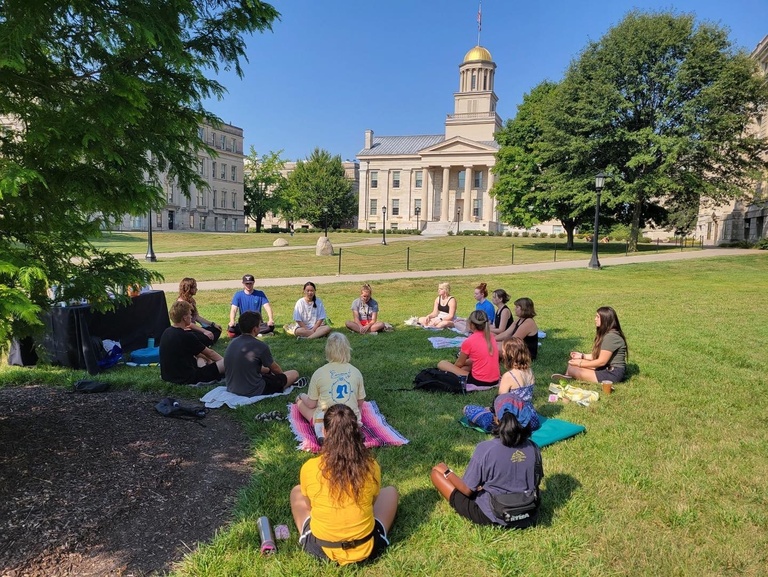
The type of events and programs offered by Student Wellness vary — there is a Red Watch Band program where students can become certified in CPR and AED for free as well as a Craft Your Calm event where students can create sensory and stress relief toys. One of their newest programs, however, is called Earthmind.
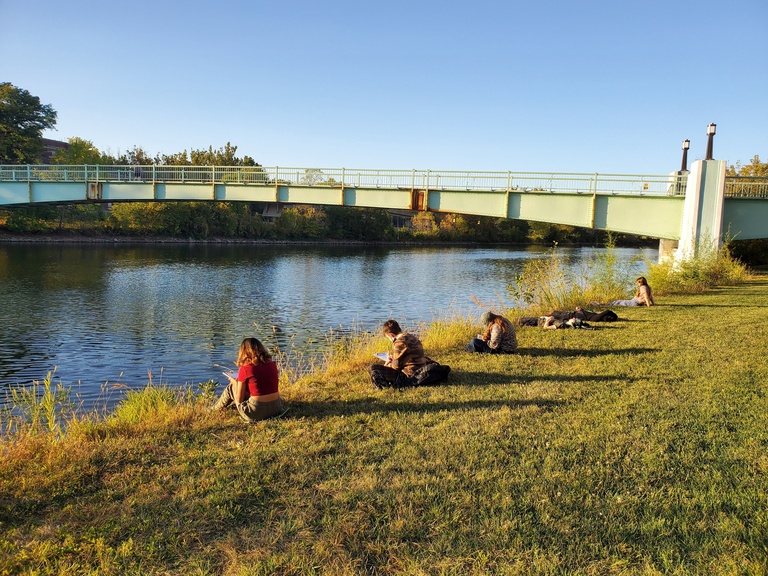
Earthmind was formed on the basis of recent studies and statistics which showed that working with soil, doing meditation by the river, or wandering in the woods provided benefits to one’s mind, body, and spirit.
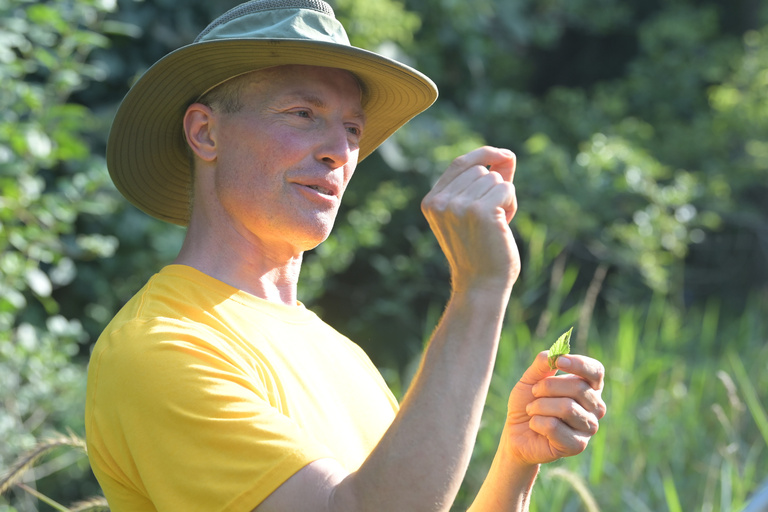
Fred Meyer, the founder and director of Iowa-based nonprofit Backyard Abundance and an adjunct professor, hopes this program will help people reconnect with nature and learn how to be mindful while doing so.
“We wanted to make sure that these classes were really hands-on so that [college students] learned these skills and then were able to immediately practice them after the class,” Meyer said. “These practices scale so that in between classes, for example, students walking outside [to their next class] can recharge their mental battery while they’re doing that walk.”
Through the years, Meyer and the Earthmind team hope to create beneficial experiences, offering four unique classes each semester. Sydney Parker, a first-year honors student, enrolled in the program and found her favorite class was tea-making.
“We made tea from roses — we took pine needles from off the tree and put that in our tea, and we tried to place the smell of herbs before we knew what it was,” Parker said. “I really liked getting to physically connect with nature. It's one thing to breathe in, breathe out, feel the waves, whatever, but it's another to be able to physically touch the earth and to touch the natural material that you're handling, so I thought that was really enriching.”
While these resources are, in the end, optional, honors students should make an effort to utilize them as much as possible. The stress that comes with a rigorous curriculum and the perfectionist mentality that many have can be all-consuming, making it difficult to care for yourself.
By itself, starting college is stressful, and not feeling mentally well can make the transition process even harder.
“You're going to be far away from your support system that you have spent your emerging teenage years with, and that's a big change,” Meyer said. “It's important to just remember you’re a human being.
“Get some sleep, eat some food, talk to people, and focus on your physical and mental wellness, just as much, if not more, as your academic performance and work performance and all the extracurricular activities, she explained. “Those are all really important too, but you are a person before you're a student.”