The Minds Behind the Music
How Rigor Meets Rhythm for Honors Students in the Hawkeye Marching Band
By Antonino Pollina
As the crowd of rowdy Hawkeye fans buzzes and roars on gameday inside Kinnick Stadium, the tension is so thick you could almost pluck it out of the air. The stars take the field, ready for hours of hard work, sweat, and repetition to pay off in their performance. They are, of course, the Hawkeye Marching Band (HMB) and among the ranks are some of the campus’s most ambitious students: members of the Honors Program.
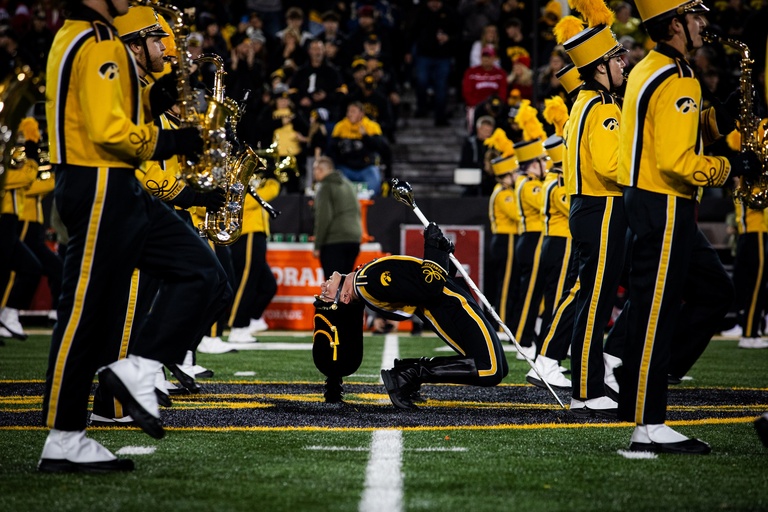
Upon first glance, the life of a marching band member and that of an honors student may seem incompatible. One is defined by late-night rehearsals, intensive physical activity, and gameday adrenaline. The other is characterized by deep study, academic research, and sometimes carrying group projects on their backs. Yet, within the hectic balancing act, these students demonstrate that it’s not only possible to get by as members of both, but thrive in the position and gain a unique advantage as a result.
To the Hawkeye fans, halftime is entertainment. To the students in the marching band, it’s the result of countless hours of practice. For many of these musicians, the workload doesn’t end there. As honors students, they participate in research, internships, or other types of experiential learning and often choose some of the most rigorous classes offered at the university.
“Even if it's 20 minutes, 30 minutes, you have to use that time to your advantage just so you can stay ahead or on track, using every single minute of the day and squeezing out those precious moment,.” said Drum Major and Iowa honors alumnus Brandon Alpers (25BA), who majored in speech and hearing sciences with minors in American Sign Language and music, and has returned to the UI for a Doctor of Audiology.
For the uninitiated, being a member of the HMB may seem like an average extracurricular. The reality is that being a marching band member is about infinitely more than just memorizing songs. Band members rehearse four days a week-, not including their gameday rehearsal and performance, practicing their complex on-field formations and movements unique to each show.
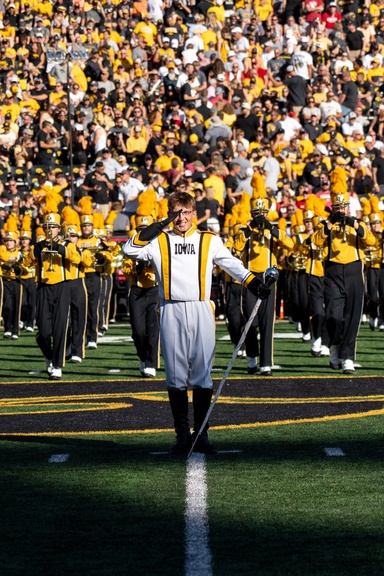
The members must be physically fit enough to march with heavy instruments for long stretches, mentally sharp enough to maintain tight arrangements, and musically proficient enough to deliver performances that meet the program’s reputation for excellence and the crowd’s expectations for a spectacle. When adding the expectations of honors students to the workload, the result is a demanding lifestyle that requires time management and unwavering dedication.
“It's a significant time commitment,” remarked Dr. Eric Bush, director of the HMB. “Seven shows a year for seven home games. We also take those shows to one or two exhibitions throughout the year as well[...]so Hawkeye Marching Band members are super resilient.”
The makeup of a marching band member and an honors student are shockingly similar when examined side-by-side. Both members must possess discipline, collaboration skills, creativity, and a tendency to take the lead to succeed in their fields.
Alpers put it perfectly: “As honors students, we're kind of coded to be overachievers, and we want to do more, we want to contribute.”
The personal confidence Alpers gained through the marching band translated to his studies and he seized opportunities in both programs, becoming the drum major and conducting research in his field of study. It’s clear that both programs feed into each other, an ouroboros of discipline and discovery.
The HMB is, in many ways, one of the university’s most visible cultural ambassadors. Every gameday, they represent Iowa to tens of thousands of fans in the stadium and even more watching from home.
“We try to embody everything that is the Hawkeye spirit,” said Bush— “from high impact participation to bleeding black and gold for football games, playing for basketball with the Iowa Pep Band, and supporting everything the university stands for.”
As the HMB celebrates its 145th season this year, it's important to keep in mind the impact both the band and its musicians bring to campus culture. Their work demonstrates that academic achievement and artistic expression are not mutually exclusive, but mutually beneficial.

About the Author
Antonino Pollina is a second-year student from Kansas City, Missouri majoring in English and creative writing at the University of Iowa. In his free time he enjoys writing poetry, exercising, and traveling to new places.