Honors and Earth
How Honors Sustainability Courses Connect Students to Nature
By Cameron Vest
Imagine you’re strolling the Pentacrest one autumn afternoon–or maybe it’s the River Walk along the Iowa River, or the hidden glen beside Bowen Science Building. You notice the trees, the flowering plants, and the insects. You hear birds calling and look up to see them flying between the tall trees and the fall foliage.
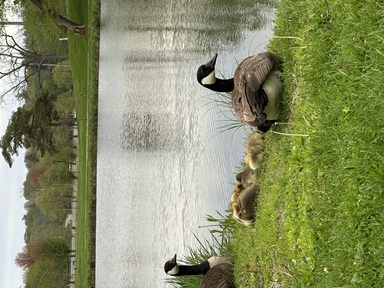
Maybe you’re a lover of nature from way back–or maybe you are one of the many honors students whose awareness stems from a sustainability course at Iowa.
Honors courses are distinguished by their emphasis on thought-provoking inquiries and diligent engagement. In sustainability courses, students learn to ask difficult questions and explore the environment firsthand, developing a connection to nature that extends beyond the classroom.
One of the most important aspects of sustainability courses is their cultivation of attentiveness to the surrounding natural world. Christopher Brochu, a professor of vertebrate paleontology who teaches the Honors Primetime course How Birds Work, emphasized the value of slowing down and simply observing one’s environment.
“I think it’s important for people to appreciate the biodiversity that’s around them,” Brochu said. “Just take a moment sometime to watch some of the plants on campus.”
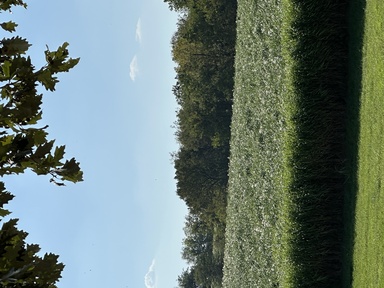
Noticing tiny pollinators or learning to distinguish tree species passed every day on the way to class is central to living with the environment in mind. A walk across the Pentacrest can showcase an entire ecology. As his students travel across the campus to study ancient plants, they learn to distinguish all types of flora.
“It’s not just a tree,” Brochu said, “This tree has meaning.”
Through teaching honors students about environmental sustainability, Brochu hopes to foster a love for the nature around them. The awareness of nature deepens with knowledge.
Shaun Vecera, director of the Honors Program and professor in the Department of Psychological Brain Sciences, echoed this idea.
“I think there’s some very good evidence that suggests you are better able to understand the environment you’re in if you have some knowledge of it,” said Vecera, who teaches a first-year seminar course titled How Psychology Can Save the Planet and the Honors Primetime Go Outside and Play: Nature, Cognition, and How to Survive in the Outdoors.
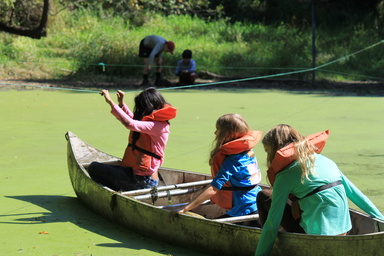
Environmental understanding begins with a healthy mixture of curiosity and experience. In practice, students might go bird-watching, learn tree identification from campus arborists, or even navigate the woods and rivers using a compass and canoe. For many students, these activities build confidence in the outdoors while revealing the biodiversity of the spaces that surround them every day.
Sustainability education also emphasizes the systems that underlie everyday living on campus, such as access to clean water and the maintenance of healthy ecosystems. Adam Brummett, an associate professor in the chemistry department, utilizes his Honors Primetime course, Sustainable Sciences, and his study abroad program to Germany and Switzerland, Sustainable Chemistry Along the Rhine, to highlight often-overlooked aspects of the university’s ecology.
Brummett’s hope is that “every time a student crosses the [Iowa River], they look at it a little bit differently, into the challenges that come with it. What does it take to make the water safe to drink?”
Through class activities such as touring the water treatment facility, Brummett encourages students to recognize how sustainable science practices are woven into the structures that support a healthy society.
Firsthand experience is vital to understanding the importance of sustainable science. Students must see, touch, and work with the land itself.

Introducing young children to Iowa’s ecosystems is the everyday work of honors alumna Rubye Ney, who graduated with a BA in elementary
education in 2023 and received her master’s degree from Arizona State University. Ney works with the School of the Wild, a K-12 outdoor education program spanning 44 counties across the state.
“A lot of the work we do starts with inquiry and question-asking, getting students to be more curious about the natural world around them,” Ney said.
Guiding students through wetlands, woodlands, or prairies, Ney builds the foundation of environmental education. Her work mirrors the educational values college students experience in honors sustainability courses: cultivating curiosity, encouraging questions, and fostering a respect for the natural world.
At a time in history when ecological challenges are omnipresent and urgent, the lessons students carry away from these courses are invaluable. They leave not only with knowledge but with a sense of wonder and responsibility. Whether observing pollinators at work, distinguishing among tree species, or visiting a water treatment facility, the act of noticing the fine details born from curiosity and experience is one of the most meaningful contributions environmental honors courses offer to both students and to the world they will help shape.

About the Author
Cameron Vest is a second-year student from Mequon, Wisconsin. He came to the University of Iowa to pursue a major in English and creative writing on the publishing track and a certificate in environmental sustainability. He enjoys reading and writing fantasy and sci-fi and hopes to write his own books in the future.