Honoring Their Majors
Alumni Look Back on The Benefits of Departmental Honors
By Ansley Tonkovic
Imagine the ability to create and design a research project of your choice, about a topic that you choose. Honors in the Major offers this opportunity to both honors and non-honors students, allowing them to make a deeper connection within their major through both research and creative work.
According to two recent Honors Program alumni, the benefits of pursuing it ranged from career-related experience to self-discovery.
“I wanted to have practice working on a large research project,” said Elisa Burba (25BA). Like many students, Burba decided to pursue Honors in the Major because of the preparation it provides for graduate school.
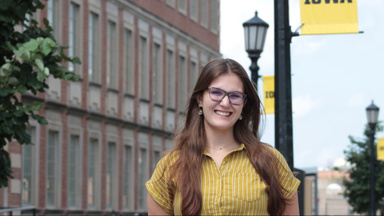
Burba graduated with a BA in English and history in May and is currently in her final year of a Master of Arts in library and information sciences at the University of Iowa. She completed Honors in the Major for history, which she explained was a year-long process. In the spring semester, students participated in a research-driven course which helped narrow down their topics, and at the end of the fall semester, the students turned in their final drafts.
“Being able to develop a research proposal and work on a topic I was passionate about was incredibly fun and rewarding,” Burba recalled.
Burba focused her research on the lives of Floy Eugenia Whitehead and Margaret Keyes, two home economics professors at the University of Iowa in the 1950s-60s. Whitehead’s and Keyes’s papers are held in the Iowa Women’s Archives in the Main Library, where Burba pored over the collections.
“I wrote and rewrote my thesis, eventually landing on using Whitehead and Keyes as case studies through which to examine the lives and homosocial relationships between women after World War 2,” she said.

Burba also had the opportunity to present her research at the Fall Undergraduate Research Festival (FURF), using her thesis, “And They Were Roommates: The Story of Margaret Keyes and Floy Eugenia Whitehead.”
Burba believes participating in Honors in the Major benefited her and would recommend it to students who are on the fence.
“Not only did it give me a great writing sample for PhD applications, but it also gave me hands-on experience in archives and special collections, which has been invaluable for my work,” she said.
Students who complete Honors in the Major receive 12 experiential learning credits for University Honors, which is partly why alumnus Mason Koelm (21BA, 21BS, 24JD) decided to pursue it.
“It was the easiest way to ensure I would meet the experiential learning requirement for graduating with University Honors, and it meant I’d have a special line of text on my degree too,” said Koelm, who is the current developmental director for United Action for Youth, a nonprofit in Iowa City offering parenting and mental health resources, as well as temporary housing for middle and high school students in Johnson County.
Koelm was a double major in international relations and criminology, law, and justice. Pursuing Honors in the Major in criminology, Koelm chose to research the international trafficking of illegally excavated archaeological materials. “I got to choose the topic and had a lot of freedom in how I approached the issue, as well as how I structured the paper and when I worked on it,” Koelm recalled.
Koelm recreated an earlier study, compared alternative measurements for variables they had introduced, and looked at the interactions of new variables, including whether the “source” country had signed onto international treaties governing archaeological trafficking.
Importantly, the opportunity to try something new through Honors in the Major led to moments of self-discovery and personal growth. “Those qualities are the backbone of all experiential opportunities within the Honors Program,” Koelm stated. “You can learn about psychology, or biology, or history, or journalism, or any other field in a classroom, but you’re gonna learn the most about yourself outside of the classroom.”

About the Author
Ansley Tonkovic is a freshman at the University of Iowa. She’s originally from Florida and is majoring in journalism and mass communications. She loves listening to music and her favorite dinner spot in Iowa City is Formosa. Her favorite book is Frankenstein and her favorite movie is Gladiator. After graduation she hopes to become a political reporter.