Growing Through Honors
Navigating Change as a Transfer Student
By Blanche Nery
When I transferred to the University of Iowa from San Diego State University during my sophomore year, I wasn’t sure how I would find my place on such a large campus. Leaving SDSU wasn’t a choice I wanted to make, and although I knew coming home was the right decision financially, I arrived at Iowa with a closed-off mindset, uncertain of what awaited me.
With some college experience behind me, I didn’t necessarily see myself as a ‘new student,’ but I was still brand new to Iowa City, the university, and all the opportunities waiting here. It was through my sorority, Kappa Alpha Theta, that I first learned
about the Honors Program.
In my marketing strategy class, I was talking with my sorority sister, Mikenna Meadows, a fourth-year marketing student, who has been involved in Honors since her freshman year and is a current member of Women in Business. I mentioned how much I preferred a smaller, more engaging classroom, and she immediately told me about Honors and encouraged me to join.
She explained that Honors challenged her academically through rigorous coursework and smaller classes, while also giving her a strong sense of community. The Honors Program has been one of the most influential parts of her time at Iowa.
That conversation changed everything for me. I realized the program offered exactly the kind of learning environment I had been seeking. Curious about honors classes, I asked Meadows which courses she recommended, and which had been the most valuable for her. She shared that her Business Communication and Protocol honors class had been the most impactful, particularly in teaching business etiquette and effective peer communication.

She explained that the group projects in that course strengthened her collaboration skills and reinforced her appreciation for honors classes, where students are consistently engaged, prepared, and committed.
Once I joined the Honors Program, I quickly noticed its ripple effects in other areas of my life.
In Women in Business, for example, I met classmates like Caroline Reynolds, a double major in finance and insurance on the pre-law track. Reynolds has been involved in the Honors Program since her freshman year, served as director of external relations for Undergraduate Student Government, held the role of director of facilities management for Kappa Alpha Theta, and even interned for Senator Joni Ernst in Washington, D.C.
Watching her leadership both in the classroom and across campus organizations inspired me to step up. When I asked Reynolds how Honors helped her discover leadership opportunities, she explained that it connected her with other driven students who encouraged her to step outside her comfort zone. Her example motivated me to do the same.
My first leadership role came when I applied to be Vice President of Marketing for Women in Business, where I manage the social media, merchandise, and graphic design, giving me the chance to apply concepts I was learning in real time. I was curious about how Reynolds' experience in Honors influenced her career goals.
She told me that her honors mentors motivated her to pursue new experiences and challenged her to think deeply about how her interests in finance, insurance, and law could align. Hearing how her mentors and peers pushed her to grow reminded me that support systems like Honors can spark growth for anyone willing to get involved. Whether through my sorority, student organizations, or honors events, I’ve discovered that transfer students like me can find immediate ways to get involved, grow, and thrive.
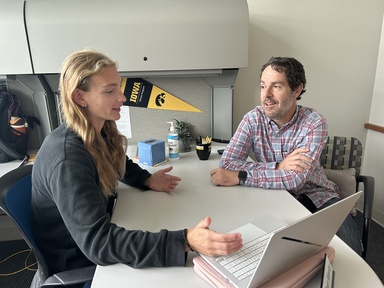
My own experiences are also connected with insights I gained from a conversation with Mark Archibald, who has worked at the university for 14 years and joined Honors two years ago. He oversees admission processes, record keeping, and graduation tracking for Honors students.

Archibald shared with me that he recently proposed a new idea: meeting one-on-one with transfer students before they join, to help them determine if Honors is the right fit. His goal is to ensure that transfer students not only understand what the program offers but also feel supported in deciding how Honors can fit into their unique journey.
Archibald’s advice resonated with me: “Get involved in different ways, not only through Honors but also by attending events in your community.”
He emphasized that community in honors takes many forms, whether it’s in a classroom, through research, or even in the Honors building itself.
As he explained, “Honors students are known to multitask, and we’re not trying to be everyone’s community. We are a part of your life, but not most of your life. Honors isn’t about making it above everything else; it’s about making specific goals.”
That perspective perfectly sums up my own honors experience. Honors has never been about adding more to my plate for the sake of it; it has been about choosing meaningful opportunities that align with my goals. For me, that has meant smaller, more engaging classes, leadership opportunities, and friendships that push me to grow.
My advice for other transfer students is to say yes to unexpected opportunities. Honors does not have to take over your life, but it can add meaningful layers to your college experience. It’s not just about the honors designation at graduation, it’s about the experiences, the leadership skills, and the relationships you build along the way.
Looking back, I’m grateful that one conversation in my sorority led me to Honors. And now, with mentors like Meadows, Reynolds, and the guidance of leaders like Archibald, I can see how it provides transfer students with the chance to connect, contribute, and thrive, and I’m proud to have found my place here.

About the Author
Blanche is a third-year student from West Des Moines, Iowa, studying marketing with a minor in media management and holding a certificate in entrepreneurial management. In her free time, she enjoys baking banana bread.