Certificates and Sports Clubs
How Students Align Their Schedules with Their Passions
By Jenna Crowley and Nolan Barrett
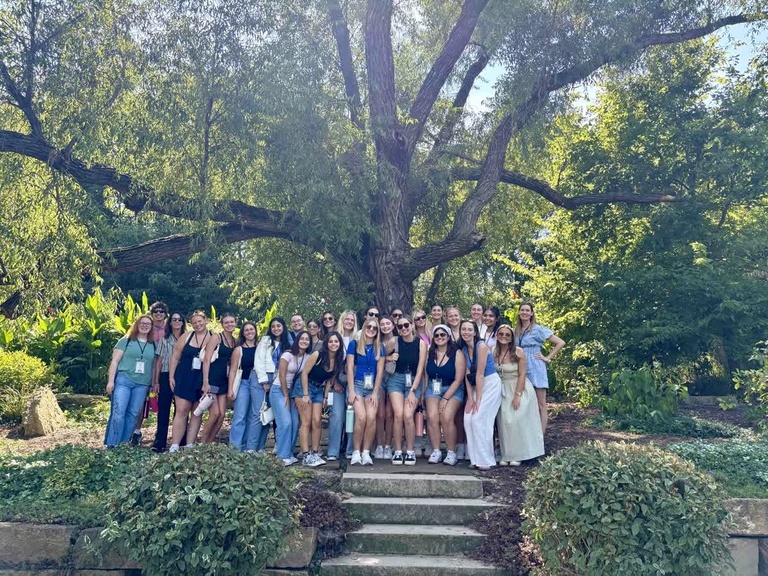
Second-year student Daniela Gal’s weekly calendar rivals an elaborate tongue twister.
Gal studies speech and hearing science with a certificate in disability studies, with involvement including the National Student Speech Language Hearing Association (NSSLHA), the Communication Sciences and Disorders (CSD) Research Club, and the Sigma Chapter of Alpha Chi Omega Sorority.
Gal sat in the cozy glow of Java House as she listed off her extensive plans for grad school. She hoped that her extracurriculars at Iowa would shape her into a well-rounded student and person, fit to support her community in speech pathology–a passion she has had since her high school’s Exceptional Learner Program.
Gal served as a unified partner of the Special Olympics, where she was inspired by the people she met.
“I was like, ‘I want to do something involved with disabilities.’ So that’s what made me choose speech and hearing sciences: to become a speech pathologist,” Gal recalled. Pursuing the certificate in disability studies “just helps me understand disabilities more,” she added.
Gal is just one of many honors students who declared certificates on their paths towards graduation.

Honors students tend to find themselves with a lot on their plates. Synthesizing your endless catalog of high school interests into just one broadly-named major, or two, is a daunting task. With schedules overflowing with athletic and intellectual clubs, a myriad of student organizations, and general education (GE) requirements each semester, some may still feel the need to fill a hole that the college transition left in its wake.
For Gal, the best way to expand her horizons was by researching classes not as readily available on her major’s general course list. As of Spring 2026, the University of Iowa offered 32 certificates for any given major to include in their path towards graduation.
These certificates are intended for students with multiple creative and academic interests, students seeking a more specified course of study within a broader major, undeclared students exploring options, and those with advanced placement (AP) and dual-enrollment credit with a flexible degree audit.
“I talked to my advisors,” Gal explained, “and my major and certificate overlapped with a lot of classes I could take anyway, so I thought it’d be a perfect fit.”
Those on the pre-law track who have a longstanding love for history might include a medieval studies certificate in their courseload. Nursing students may find the available curriculum in the critical cultural competence certificate illuminating for interactions with future patients. A religious studies major might find the College of Engineering’s certificate on artificial intelligence, modeling, and simulation a useful addition to their repertoire.
“Exploring what you might be interested in other than your assigned major is important–to figure out who you even are,” asserted Gal.
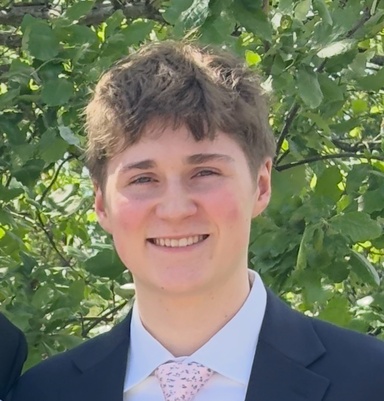
Records, Enrollment, and Analytics Specialist Mark Archibald has witnessed the number of honors students enthusiastic about having multiple programs of study, including certificates. According to his database, honors students have up to ten programs of study declared. Students are able to declare and remove their minors and certificates as they please, and Archibald encourages them to test out options that might appear outside of their comfort zone.
“It’s the difference between taking a risk about something that you’re kind of on rocky ground about, and then something that you know you have passion for. You just have to kind of take the step,” he said.
If the additional hours of a certificate do not appear in the cards for your graduation plan, exploring the courses they offer may still be a fruitful exploration. Honors Peer Mentor Nina Osborne, a double major in environmental policy and planning & geographic information science, enrolled in a few classes with the applied climate technology certificate before realizing it was not a fit for her.
Though Osborne remains a fan of certificates, her schedule now features a world of extracurricular options that keep her weekly routine colorful, one of them being the triathlon club.
Triathlon is just one of the 42 competitive sport clubs offered by the University of Iowa Recreational Services department. Athletics is an area in which college students are often disconnected from their daily lives in high school, but for many students like Osborne, club sports offer a happy medium between the casual nature of intramural competition and the high-intensity commitment of collegiate athletics.
“Clubs are just such a great environment to meet people who are interested in things that you’re interested in,” Osborne said.
For many students, sports have significance beyond winning and losing.
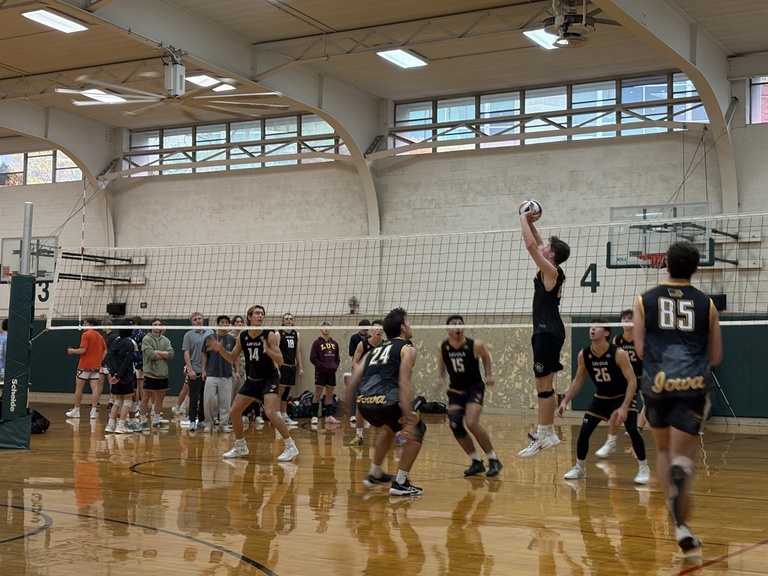
For first-year honors student Mathew Rife, an undeclared business student, competitive volleyball was not an activity he was willing to leave behind in college. Rife played volleyball for over 11 years before college, a crucial feature of his life. For students like him, athletics play a vital role in the work-life balance needed to succeed in college.
As both a physical and social activity, sports clubs also serve as a stress reducer, which is the case for Rife with the UI’s Men’s Volleyball Club.
“It’s some place to go, relieve some stress, get away from staring at a computer,” Rife said. “It's my version of therapy. It has been for a long time.”
Club sports also offer benefits not often associated with athletics. Foremost is network building. Similar to school and club athletic programs popular before college, many of the sports clubs at Iowa offer the ability to travel to other schools and meet new people.
Recounting his experience with the team, Rife said, “There are guys there from all different years, all different majors, so I get to learn about what they do or some of the organizations they're involved with.”
Regardless of what route students take to enrich their undergraduate experience, any honors student hoping to reignite the excitement they first found through high school activities have several avenues to do so. Explore Iowa’s websites for available certificates, club sports, and student organizations, or, better yet, ask honors peer mentors or classmates about their own extracurriculars.
Just like Gal, they are happy to share about the passions that drive their days in Iowa City and beyond.
Advising fellow students, Gal said, “It might not be what you’re gonna study, but it’s still a great way to find people who will lead you to a path that you do like.”

About the Author
Nolan is a second-year student studying political science on the pre-law track and working towards a writing certificate. From Los Angeles, California, Nolan hopes to attend law school in New England after graduation.

About the Author
Jenna Crowley is a fourth-year student studying English on the publishing track with a minor in communication studies. Originally from San Diego, California, Jenna has also developed an interest in museum studies and event management during her time as an undergraduate.